Posts

Surprise them (and you) with kindness

Image
    “It's not our job to toughen our children up to face a cruel and heartless world. It's our job to raise children who will make the world a little less cruel and heartless.” L.R. Knost   Our world is cruel and harsh at times. Injustice, violence and poverty have become pictures of our everyday life all fueled by pain and suffering. Our environments have become competitive – survival instincts take over and hurt from our past and backgrounds take over. Look around, ask how many people are on antidepressants and medication for their mental health – do we solve the cruelty of the world that is painful or we learn to live with it? All doom and gloom?? If you have read my blogs before, you know that I tend to recognize the bad but focus on the good – maybe to help myself too… Our hope is our kids – cliché, right? The current theme in our family recently is kindness. It started some time ago with a “kind challenge” – which we are reintroducing now. We all get to...
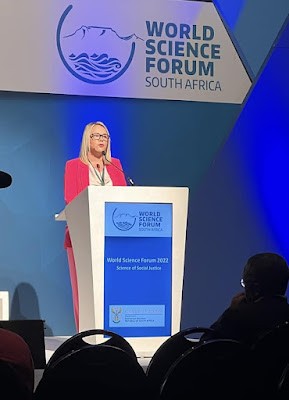
Science that listens and collaborates

Image
(World Science Forum 2022 Cape Town )   Scientific and technological progress is a reality; sometimes, in some cases, faster and in others, slower. The question that comes to mind and is of concern is why these technological advancements do not reach society fully and how we struggle to achieve the UN Sustainable Development Goals.  In typical Global Young Academy (GYA) and Science Leadership Programme (SLP) practice, we see all challenges as opportunities for change, and our discussions for solutions start with "how might we...?" and "how can we...?". Then the power and responsibility are on us to make the change. So, how might we unblock the channels of influence of science and technology to unblock or assist more than we already do with greater societal challenges?  ..or how might we overcome the hurdles? I am sharing here two thoughts: 1) Communication of science And as soon as we read/hear this, we all tend to focus on how we, as scientists, communicate our fin...

My whole...

  Yes, I am an academic                                           no,  I am not only that Yes, I am a mother                                                 no, I am not only that Yes, I am a wife                                                      no, I am not only that Yes, I am a friend                                                   no, I am not only that Yes, I am a daughter               ...

My student-centred view of academia

Image
 During my sabbatical year (yes, the one during the pandemic that didn’t allow me to travel much – no, I am not sour at all about it…), I had time to reassess who I am professionally and what I want to do in my career. In the end, I discovered that I am a cheerleader, encourager, and coach. “Yes!” I jumped off my chair and managed to wake Mr Charlie and Mr Toumba from their afternoon nap. “That’s who I am! I am an Economics Research Coach”. What does this entail, though? Students and students and more students. But wait. Is this not part of being an academic anyway? One of the definitions of the word academic is a person who teaches at a college or university. The mere definition of the word academic starts with the idea of teaching. An academic, however, is so much more than just a channel of transferring knowledge to students. An academic is one that produces knowledge and prepares those that will produce more knowledge. Coming back this year, I have started observing int...

Red riding hood and the Big Bad Wolf: Advice for effective science communication

Image
  The GYA Science Advice Resource Centre is a platform that provides basic information on Science Advice. This platform is intended to be an initial entry point for Early-Career Researchers in Scientific Advice matter. The Science Advice Working Group of GYA initiated this work by integrating essential literature in the field of Science Advice, Science Policy-making, Science Diplomacy and Science Communication. For each of the fields, the platform provides a number of academic articles "translations".  My contribution to the database is titled " Red riding hood and the Big Bad Wolf: Advice for effective science communication ". Highlights of the summary:  It should be admitted that cognitive biases usually blamed on policymakers are also found in the scientific community.  There are three things to consider to establish an effective communication channel between scientists and policymaking: selective information to be shared, appropriate timing to act, and engagem...

Get organised – the yes edition: decluttering the do-list

Image
 “Stop saying yes to everything…Learn to say no….”  This is the first piece of advice you will get if you look for ways to lower your load, find a better balance in your life, and avoid reaching overload and burnout. Over the last six months or so, I have had the opportunity to work with a life coach via an academic leadership programme. Having too many things on my plate and being constantly busy was the first thing that came out from my self-reflection and how others see me. Let me get that right now. I need to stress that these things are related to all the extra things an academic does and, indeed, not the standard components of one’s job. Academics also demonstrate academic citizenship by participating in projects, associations, think tanks, and committees. Also, an academic’s job is flexible, which can be a benefit and a vice at the same time: it can be used efficiently to prevent burnout (Friday morning breakfast with friends is possible because I can work at any ...

To the friend-that-left and the friend-that-came….

Image
They say that the pandemic and lockdowns brought to the surface all the realities, all the facts, all the inequalities and all the feelings. Families grew stronger in the last two years, but also families broke. Going through loved ones’ losses and illnesses, hearing about other people’s losses, and being in constant fear of a phone call that would change our life has made us all re-evaluate our priorities and the significance of emotions and relationships. Such “exercise” happened consciously in some cases, but mostly without us even understanding that the process has been in action… Social norms and obligations subdued during the last two years. We didn’t get to see people every day at work, so our relationships became intentional. Very simply put, who did you long to see when in lockdown? When could you visit only a few people, which ones did you choose? Who was there when you just needed to rant about a difficult day? On top of this, we all expressed opinions and thoughts tha...